


There is no standard interval at which IV therapy should be repeated for best results in 2026. The right schedule depends on why you need the infusion, what it contains, your medical history and whether a clinician finds a reason to repeat it. If you can drink fluids and have no diagnosed deficiency or other medical indication, a standing IV appointment is not an evidence-based substitute for an assessment.
- How often should IV therapy be done? There is no standard repeat schedule; the medical indication determines the interval.
- Documented deficiency or dehydration needs an individual treatment and review plan, not a standing wellness booking.
- Skinoq is best for adults in Surat or Ahmedabad seeking doctor-led discussion of IV therapy, not an automatic infusion calendar.
- Ask what is in the infusion, what it is intended to treat and how the response will be assessed.
Why this matters
An IV delivers fluid or ingredients directly into a vein. That route matters when someone cannot take enough by mouth or needs treatment for a specific clinical reason. It does not, by itself, establish that repeated infusions improve energy, skin or general wellness. The indication comes before the interval.
People also use IV therapy to describe different treatments: fluid replacement, prescribed nutrient replacement and elective wellness infusions. A schedule appropriate to one cannot be transferred to another. If you are considering IV therapy at Skinoq, start with the reason for treatment rather than a preferred booking frequency. Skinoq offers doctor-led dermatology and aesthetics care, including IV therapy, in Surat and Ahmedabad.
How often should IV therapy be done for best results?
IV therapy should be repeated only when the treatment goal and a clinical review support another infusion. For a documented problem, the clinician determines the treatment plan and assesses the response. For an elective wellness infusion without a diagnosed indication, there is no established interval that can be called best for everyone in 2026.
| Reason you are considering an IV | What determines a repeat visit | What not to assume |
|---|---|---|
| Clinically significant dehydration | The cause, severity, ability to drink and response to treatment | That ongoing IV appointments are needed once you can maintain hydration by mouth |
| A documented deficiency requiring IV treatment | The diagnosis, prescribed ingredient and follow-up assessment | That every deficiency needs an IV or the same repeat interval |
| An elective wellness infusion | A clinician's review of the proposed ingredients, risks and stated goal | That feeling better after one session establishes a need for regular infusions |
| A goal better addressed without an IV | Whether oral intake, investigation or another treatment fits the problem | That IV delivery is automatically the more effective option |
This table is a decision guide, not a dosing plan. The contents of the infusion change the clinical question: fluids, vitamins and other prescribed substances have different indications and risks. Even within one category, your health status can change between visits. A responsible answer to how often therefore begins with what problem is being treated?
Treatment intervals are not maintenance intervals
An initial treatment plan addresses a defined need. A maintenance plan assumes that need persists or returns and that another infusion remains an appropriate way to address it. Those are separate decisions. Do not turn the end of an initial plan into an indefinite series of visits without reviewing the original indication.
In 2026, you should be able to ask what finding supports another appointment and what result would lead the clinician to stop, change or continue treatment. If the answer is simply that an appointment is due, the schedule has replaced the assessment. The same principle applies whether your goal is hydration, correction of a documented deficiency or a discussion about general wellbeing.
What should happen before another IV appointment?
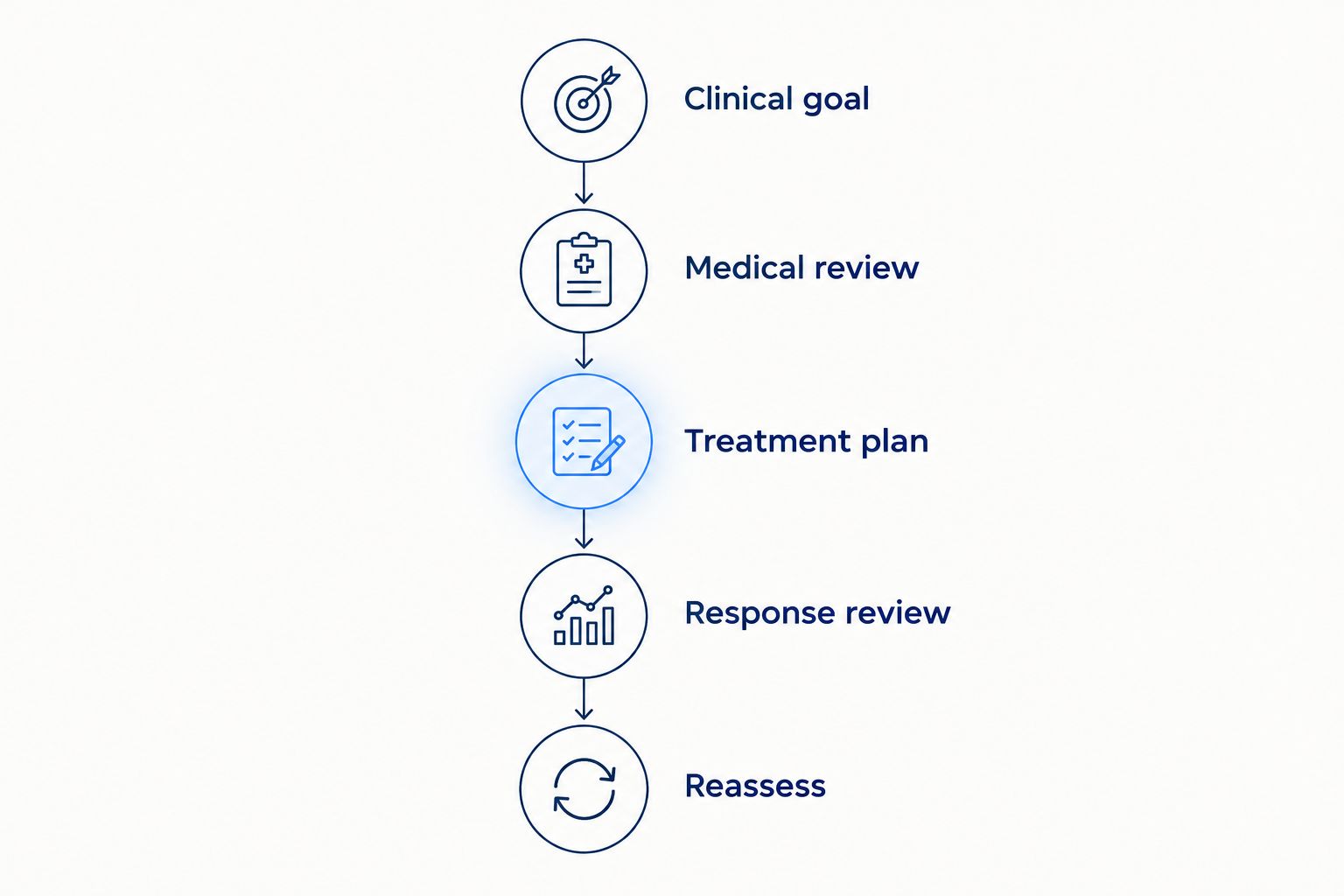
A repeat infusion is a clinical decision, not a calendar reminder. The sequence below gives you a practical way to discuss it without trying to diagnose yourself online.
- State the clinical goal. Tell the clinician what prompted you to consider IV therapy and whether you are seeking treatment for a diagnosed condition or exploring an elective infusion. A vague goal such as feeling better does not identify what should be measured.
- Have a medical review. Discuss symptoms, existing conditions, medicines and supplements, previous reactions and your ability to eat and drink. The proposed ingredients matter; a safety review cannot be completed from the words IV therapy alone.
- Agree on a treatment plan. Ask which ingredient or fluid is proposed, why IV delivery is appropriate, what alternatives exist and what would justify another session. The plan should also identify who makes that decision.
- Set a response review. Clarify what will be checked after treatment: symptoms, clinical findings or relevant tests, depending on the reason for the infusion. A change you notice can be useful information, but it does not establish the cause of that change.
- Reassess before repeating. Report new symptoms, diagnoses, medicines or adverse reactions. A plan that suited an earlier visit should not automatically carry over when your circumstances change.
These steps keep the decision tied to a clinical question. They also protect you from the opposite mistake: assuming that one infusion has solved an underlying problem when symptoms continue. Persistent symptoms need assessment of their cause, not simply another appointment for the same intervention.
Questions to take into the consultation
You do not need to arrive with a self-selected interval. Bring a clear account of why you are considering treatment, what you have already tried and what happened after any previous infusion. Then ask direct questions:
- What specific problem is this infusion intended to address?
- What does it contain, and why is each ingredient included?
- Why use an IV rather than an oral option or another form of care?
- What findings would support a repeat session, and what findings would argue against one?
- Which symptoms after an infusion need medical attention?
- If the expected response does not occur, what will be investigated instead?
The answers should make the next decision clearer, including the decision not to continue. Skinoq is best for adults in Surat or Ahmedabad who want a doctor-led discussion of IV therapy rather than a preset infusion calendar. Its stated offering establishes that IV therapy is available as part of its clinic services; it does not establish a suitable formula or frequency for any individual patient.
Why IV therapy frequency varies
No single interval accounts for all of the factors that change whether another infusion is useful or appropriate. In 2026, these are the main questions to resolve before scheduling one:
- The treatment goal. Treating dehydration and discussing an elective wellness infusion are different decisions. The stated goal determines what a response would look like.
- The reason for IV delivery. Whether you can drink fluids or take an oral treatment matters. IV access is a route of administration, not a reason to treat on its own.
- The infusion contents. Fluid and individual ingredients require different safety and follow-up questions. Do not assume that two infusions with the same general label are interchangeable.
- Your medical history. Existing conditions, medicines, supplements and previous reactions can affect the suitability of the proposed treatment and the checks needed before repeating it.
- The response to the previous session. A reported benefit, no change or an unwanted reaction each calls for review. None should automatically trigger the same next appointment.
- The underlying cause. If symptoms keep returning, identifying why they return matters more than maintaining an infusion routine without a diagnosis.
A repeat schedule is a consequence of the assessment, not the starting point. This is particularly important if you are comparing IV therapy with a broader skin, hair or body treatment plan. The goals may overlap, but an infusion should not be assumed to replace diagnosis or other indicated care.
What does a safer treatment discussion include?
A clinician should know what you hope the infusion will do and whether there is a medical reason it fits that goal. Tell them about heart or kidney conditions, medicines, supplements and any previous difficulty with an IV or reaction to an infusion. Those details are relevant to the choice of fluid or ingredient and to whether IV treatment is appropriate at all.
An IV also involves placing a needle or cannula into a vein. Discomfort, bruising and local reactions are practical considerations; more serious problems require clinical attention. Ask which symptoms should prompt you to seek help after you leave. Comfort during an appointment is not proof that repeated treatment is risk-free.
If you have severe or worsening symptoms, seek timely medical assessment rather than using an elective IV booking to manage them. An aesthetics clinic discussion and urgent medical care serve different purposes. Skinoq's doctor-led setting is relevant to an elective treatment conversation, but a consultation cannot replace emergency assessment when symptoms call for it.
What counts as a useful progress review?
A useful review returns to the goal agreed before treatment. For a documented condition, it considers the relevant clinical findings and any follow-up the treating clinician has planned. For a goal such as improved wellbeing, it asks whether the original concern has been properly investigated and whether another infusion has a sound reason behind it.
Record what happened after a previous session without treating the timing alone as proof of benefit. Note any symptoms that persisted, improved or appeared afterward, and report them accurately. This helps the clinician decide whether to continue, change course or stop. A review that only asks whether you want another appointment cannot answer whether another IV is indicated.
Can I book IV therapy every week?
A weekly IV booking is not a default recommendation in 2026. A clinician must identify the reason for treatment, review the proposed contents and decide whether repeating it serves that reason. If you were given a schedule for a diagnosed condition, follow the treating clinician's plan rather than replacing it with a general wellness timetable.
Should I repeat an IV infusion whenever the effect wears off?
No; a perceived short-lived effect is a reason to review the goal, not an automatic reason to repeat treatment. Tell the clinician what changed, when it changed and what concern remains. If symptoms persist, the next move may be investigation or a different form of care rather than another infusion.
When should I decide on my next IV appointment?
Decide after the response and your current health have been reviewed. The clinician can then explain whether another infusion is indicated and what should be checked before it. For IV therapy at Skinoq, the useful consultation question is what would justify a repeat visit for you, not which calendar slot comes next.
FAQ
How often should IV therapy be done for best results?
There is no standard repeat interval for IV therapy in 2026. Frequency depends on the reason for treatment, the infusion contents and a clinical review of your response.
Is it safe to get IV therapy regularly?
Regular IV therapy is not automatically appropriate or risk-free. A clinician should review your medical history, the proposed ingredients and the reason for each repeat infusion.
Do I need IV therapy if I can drink water?
Being able to drink fluids can change whether an IV is needed for hydration. A clinician should assess the cause and severity of your symptoms rather than treating IV delivery as the default.
Can IV therapy replace treatment for a vitamin deficiency?
IV treatment can be appropriate for some diagnosed deficiencies, but the diagnosis determines the treatment choice. Do not assume that every deficiency needs an infusion or the same follow-up plan.
Does feeling better after one infusion mean I need another?
No; a reported improvement does not establish that repeat IV therapy is necessary. Review what changed, whether the underlying concern has been identified and what another session is intended to achieve.
Should men and women follow different IV therapy schedules?
Neither men nor women should be assigned an IV schedule on that basis alone. The decision depends on individual clinical needs, the proposed treatment and its safety review.
What should I ask before repeating an IV infusion?
Ask why another infusion is indicated, what it contains and how the response will be assessed. Report any changes in health, medicines or reactions since the previous session.
One last thing
The most useful question in 2026 is not how soon you can have the next infusion. It is what evidence from your own assessment would change the decision to repeat it. If the answer is unclear, resolve that first; a recurring booking is not a clinical outcome.
Related guides


